Comparison of the Effects of Jump Rope Games and Rhythmic Gymnastics on the Development of Children Aged 4–5 Years in Tondomulyo Village, Jakenan District, Pati Regency
Keywords:
Jump Rope Game, Rhythmic Gymnastic, Child Development, Early ChildhoodAbstract
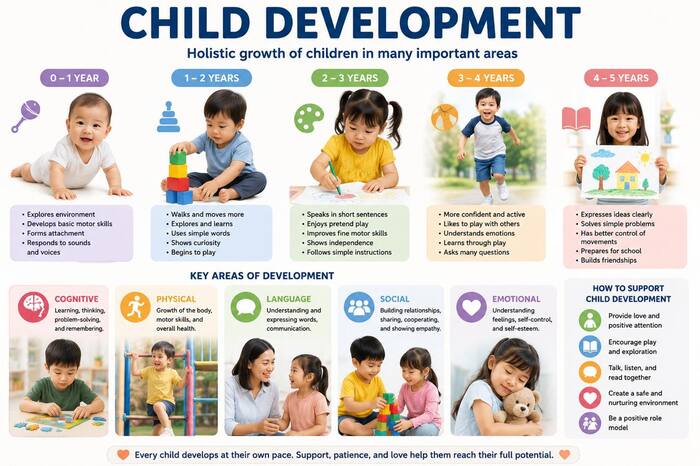
Toddler growth and development require special attention because the first five years of life, known as the golden age, are a critical period for physical, cognitive, and psychosocial development. Child development involves both quantitative and qualitative changes and can be assessed through gross motor, fine motor, language, and personal-social domains. According to the World Health Organization (WHO, 2018), growth problems among children under five include not only undernutrition but also stunting and overweight. Globally, the prevalence of wasting was 7.3%, overweight 5.9%, and stunting 21.9%. Furthermore, approximately 52.9 million children under five experienced developmental disorders in 2016, with 95% living in low- and middle-income countries. In Indonesia, the prevalence of severe undernutrition, undernutrition, normal nutritional status, and overweight among children under five was 3.9%, 13.8%, 79.2%, and 3.1%, respectively. WHO also reported a developmental disorder prevalence of 7.51% among Indonesian children under five. Rhythmic Jump Rope Game is a gross motor activity in which children jump over an elastic rope while following musical rhythms. This activity helps improve coordination, balance, and lower-limb motor skills. Rhythmic gymnastics, another music-based physical activity, is widely used to enhance gross motor development, physical fitness, and overall growth. A preliminary survey involving 15 mothers of children aged 4–5 years in Tondomulyo Village showed that all participants were familiar with jump rope games and rhythmic gymnastics as developmental stimulation methods. However, Posyandu services in the village mainly focus on growth monitoring (weight and height), while developmental assessments are rarely conducted. Therefore, this study aims to compare the effects of rhythmic jump rope games and rhythmic gymnastics on the development of children aged 4–5 years.
Downloads
Downloads
 PDF
PDF
Published
Issue
Section
License
Copyright (c) 2026 Nopri Padma Nudesti, Retno Wulan (Author)

This work is licensed under a Creative Commons Attribution-ShareAlike 4.0 International License.